
By Nishantha Bakmeege President Sri Lanka chamber garment exporters (SLCGE)
A clear national sustainable industries framework is becoming essential if Sri Lanka’s SME apparel manufacturers are to cut carbon, adopt renewable energy and remain competitive in global export supply chains.
Sri Lanka’s apparel industry is entering a new phase where export competitiveness will increasingly be measured not only by quality, speed and price, but also by sustainability, carbon performance and supply-chain transparency. For large exporters, this transition is already underway. For small and medium enterprises linked to the apparel value chain, however, the absence of a clear national sustainable industries framework is emerging as a serious policy gap.
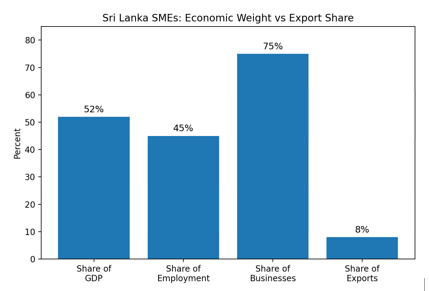
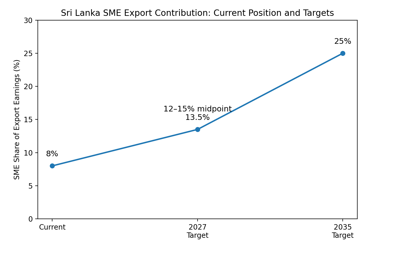
SMEs are already central to Sri Lanka’s economy, yet their export contribution remains strikingly low. They account for an estimated 52% of GDP, 45% of employment and more than 75% of businesses, but contribute only around 8% of export earnings. This mismatch matters because many SME firms are deeply connected to the apparel sector as subcontractors, accessories suppliers, printers, washers, packaging providers, logistics firms and specialist service partners.
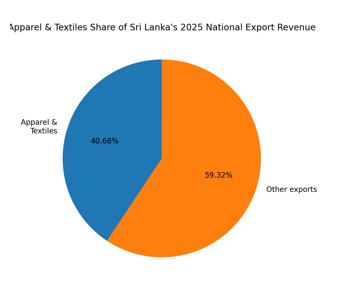
The implication is clear: if SMEs are not sustainability-ready, the wider apparel supply chain cannot be fully sustainability-ready either. Their weakness becomes a competitiveness risk for the sector as a whole. Sri Lanka’s apparel and textile industry remains one of the country’s strongest export pillars. In 2025, the sector generated US$ 5.30 billion in export revenue, accounted for 40.68% of national export revenue, and supported around 350,000 direct jobs. The industry’s stated ambition is to reach US$ 7 billion in export revenue by 2030.
That target cannot be achieved through volume growth alone. Global buyers in the US, EU and Asian markets are increasingly asking suppliers to prove lower carbon emissions, stronger environmental performance, renewable energy use, waste reduction and traceability across the full value chain. These expectations are moving beyond tier-one exporters and filtering down to SMEs that support production.
This is where the policy gap becomes urgent. Sri Lanka still lacks a practical, SME-focused National Sustainable Industries Policy Framework that gives smaller manufacturers a clear roadmap on how to measure emissions, improve energy efficiency, adopt renewable energy, access green finance and prepare for future buyer compliance requirements.
Without such a framework, the country risks creating a two-speed apparel industry: large firms that can meet evolving buyer requirements, and smaller firms that are gradually excluded from high-value supply chains. That would weaken inclusive growth, reduce the ability of SMEs to participate meaningfully in export expansion and undermine the country’s broader industrial ambitions.
The solution is not a narrow environmental policy but a competitiveness strategy. A National Sustainable Industries Policy Framework for SME manufacturers should rest on five pillars. First, it should establish a 2030 roadmap aligned with Sri Lanka’s export ambitions. Second, it should introduce practical tools that help SMEs measure emissions, energy use, water use and waste without depending on expensive consultants. Third, it should expand access to concessional green finance and tax incentives for rooftop solar, efficient machinery, wastewater treatment and cleaner production systems. Fourth, it should provide technical training through agencies, banks, industry bodies and development partners. Fifth, it should create a recognition or certification pathway that allows SMEs to demonstrate progress to international buyers.
Renewable energy should be at the centre of this effort. For SMEs, sustainability should not be framed only as a compliance burden. It should be presented as a cost-reduction and competitiveness strategy. Lower energy bills, more efficient production systems and stronger environmental credentials can improve margins while making firms more attractive to buyers.
The benefits would extend beyond SMEs themselves. Larger exporters would gain from a stronger supplier base, buyers would gain greater confidence in Sri Lanka’s supply-chain readiness, and the country would strengthen its reputation as a credible source of ethical and sustainable apparel.
A National Sustainable Industries Policy Framework is therefore not just an environmental initiative. It is an export competitiveness strategy, an SME development strategy and a supply-chain resilience strategy. For Sri Lanka’s SME apparel sector, sustainability is no longer optional. It is becoming the language of market access, buyer confidence and long-term industrial survival.

Nishantha Bakmeege President Sri Lanka chamber garment exporters (SLCGE)